
01
Design the Serving Infrastructure for an LLM-Powered Feature
Practice
- capacity estimation
- GPU economics
- continuous batching
- autoscaling signals
- latency vs. throughput
- token streaming
Core Practice Edition · Vol. 1
A practice-first workbook for SDE-2 / SDE-3 engineers. Five complete interview simulations, stop gates that make you commit before you read, and a 32-point self-grading rubric.
127-page professionally designed PDF · Instant download · Lifetime updates to Vol. 1
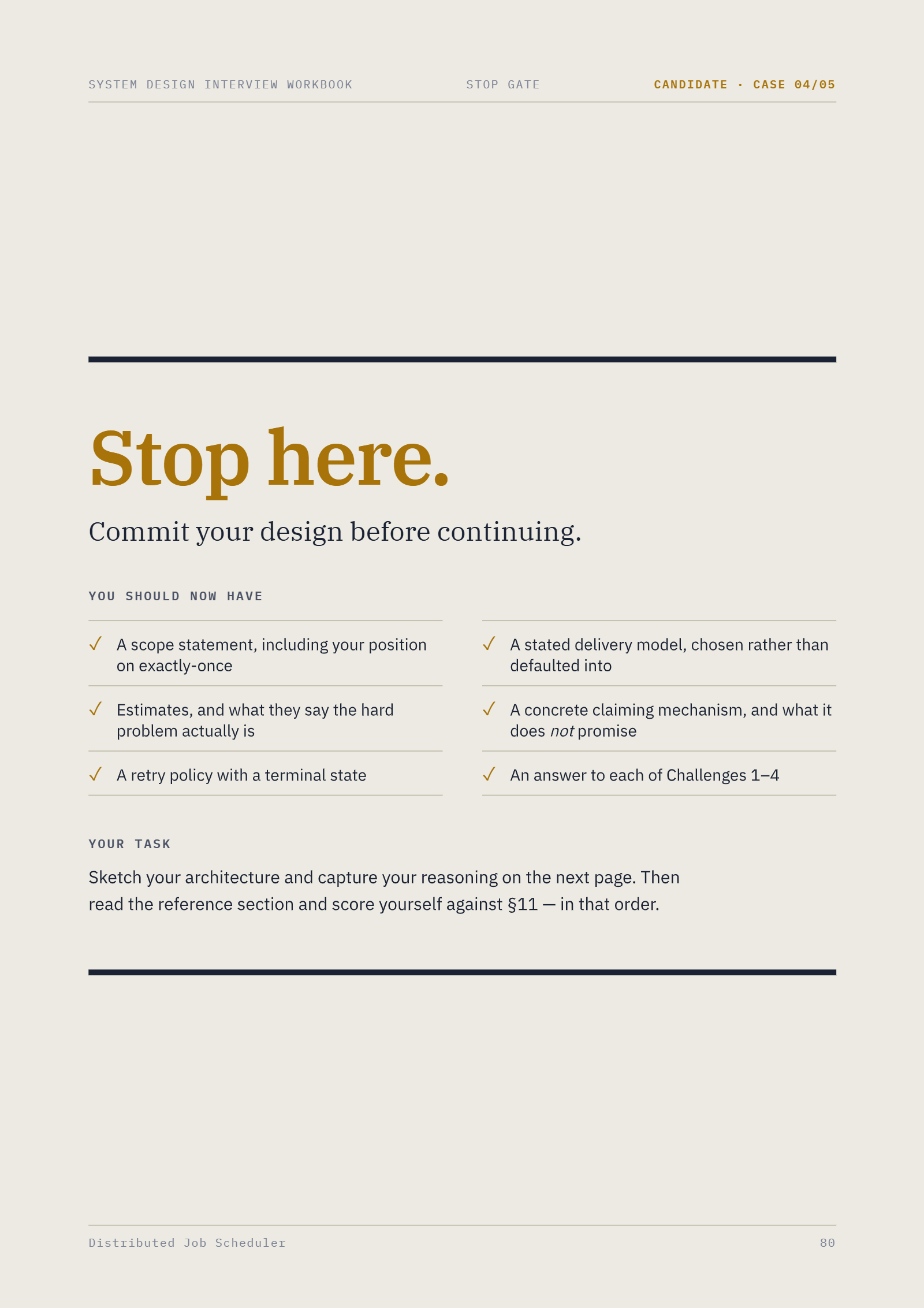
Stop gate
Do not read further until you have written your capacity estimate — request rate, GPU count, and cost per hour. The answer on the next page is worthless if you haven't committed to yours.
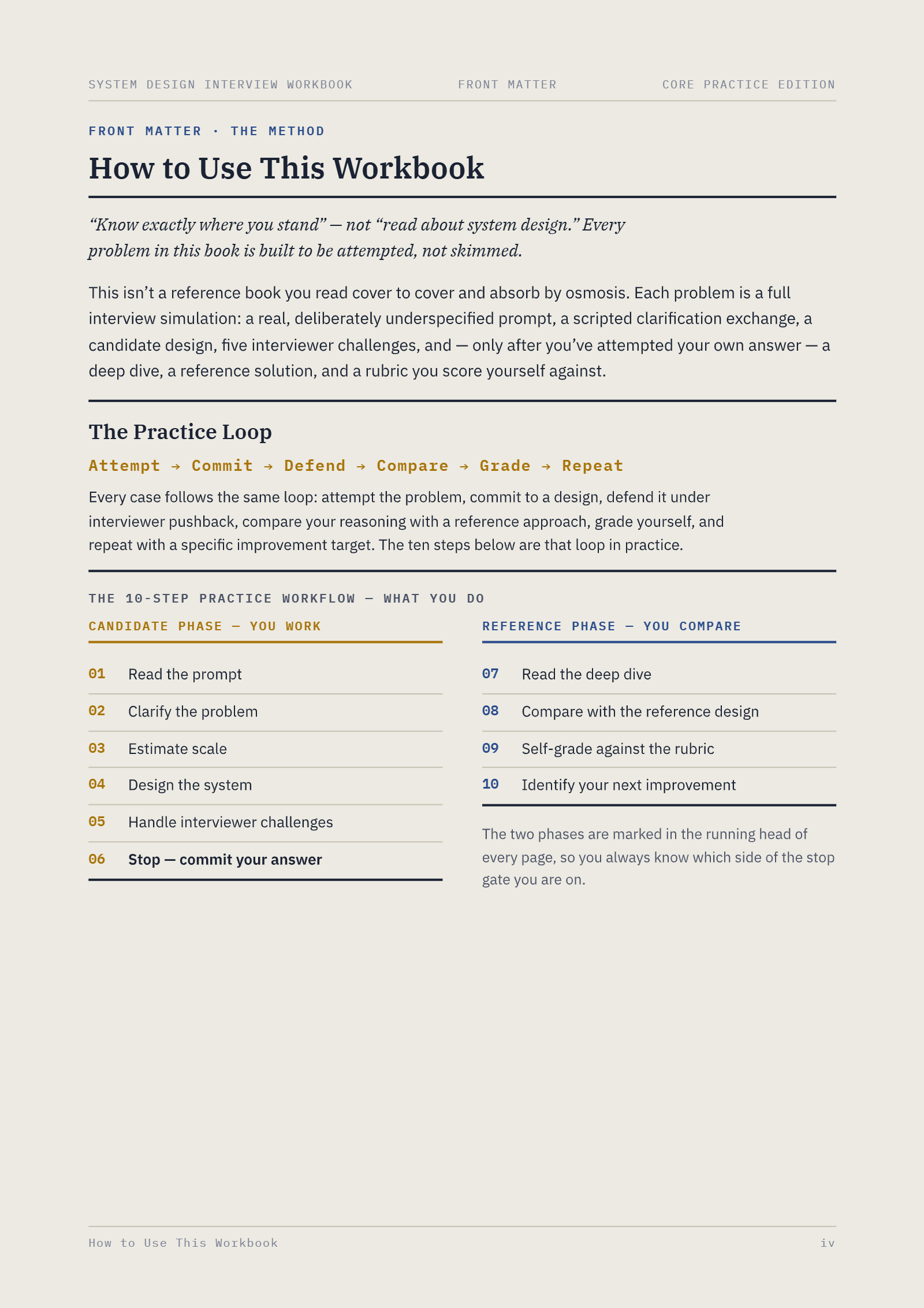
The mechanics that make this a workbook, not a book.
New · Volume 2
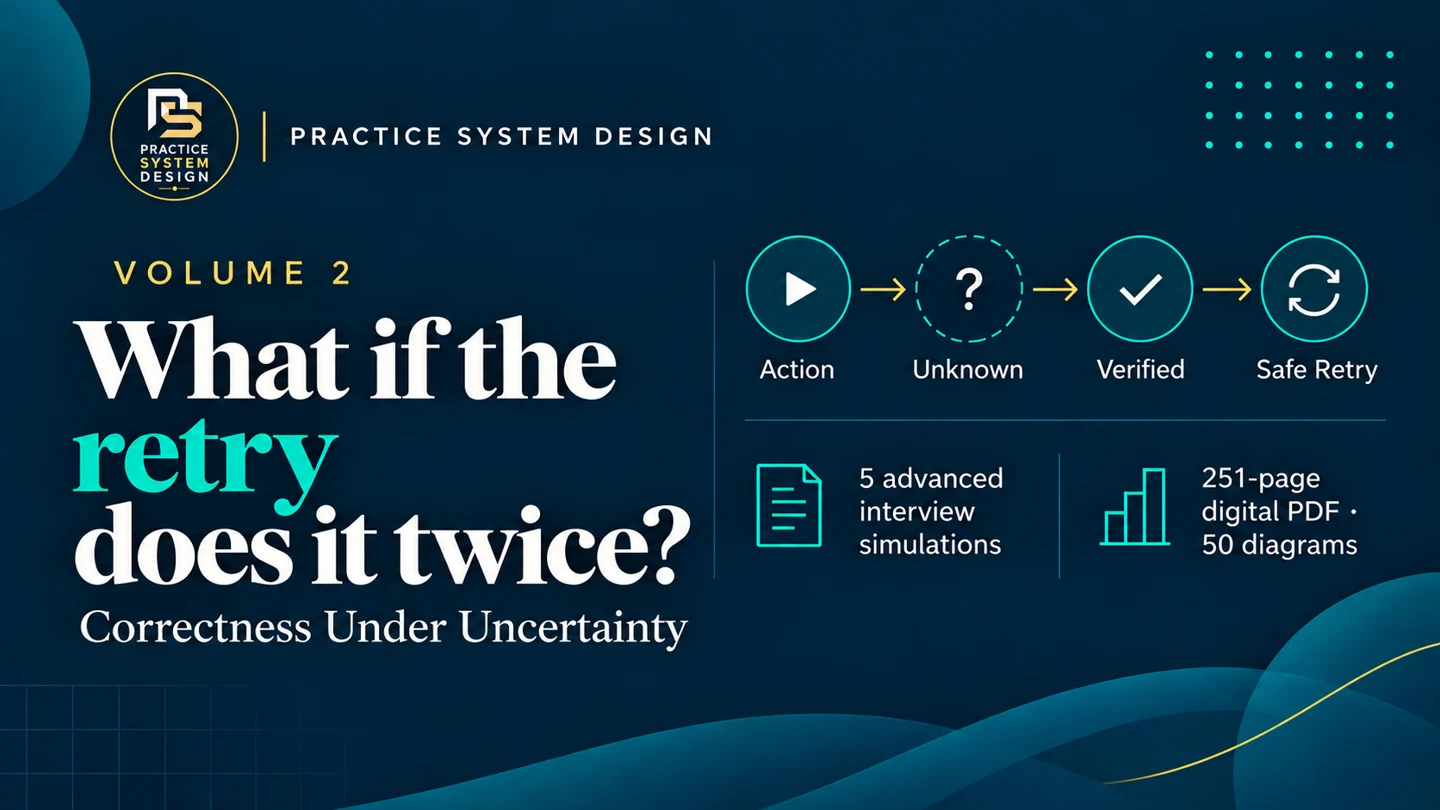
The advanced companion to Volume 1: five interviews where the obvious answer breaks — retries, stale authorization, deletion, decision stability, and contention. A 251-page workbook with 50 diagrams and the D1–D8 self-grading rubric.
Free sample · no risk
Not sure it's for you? Download the free 12-page preview and attempt the opening stages of a real Practice System Design simulation — actual workbook pages, not a brochure. It stops right before the reference solution: you get the exercise; the full analysis, benchmark solution, and remaining four problems are in Volume 1.
The problem
Most prep material lets you nod along to someone else's answer. In the interview, nodding isn't available. This workbook is built around three mechanics that force real practice.
At every decision point the book stops you: write your requirements, commit to your capacity math, sketch your architecture. Only then do you compare against the reference solution. No passive scrolling.
Interviewers probe with plausible-sounding but wrong directions. Each problem includes decoy questions that train you to recognize when a follow-up is testing your judgment, not your memory.
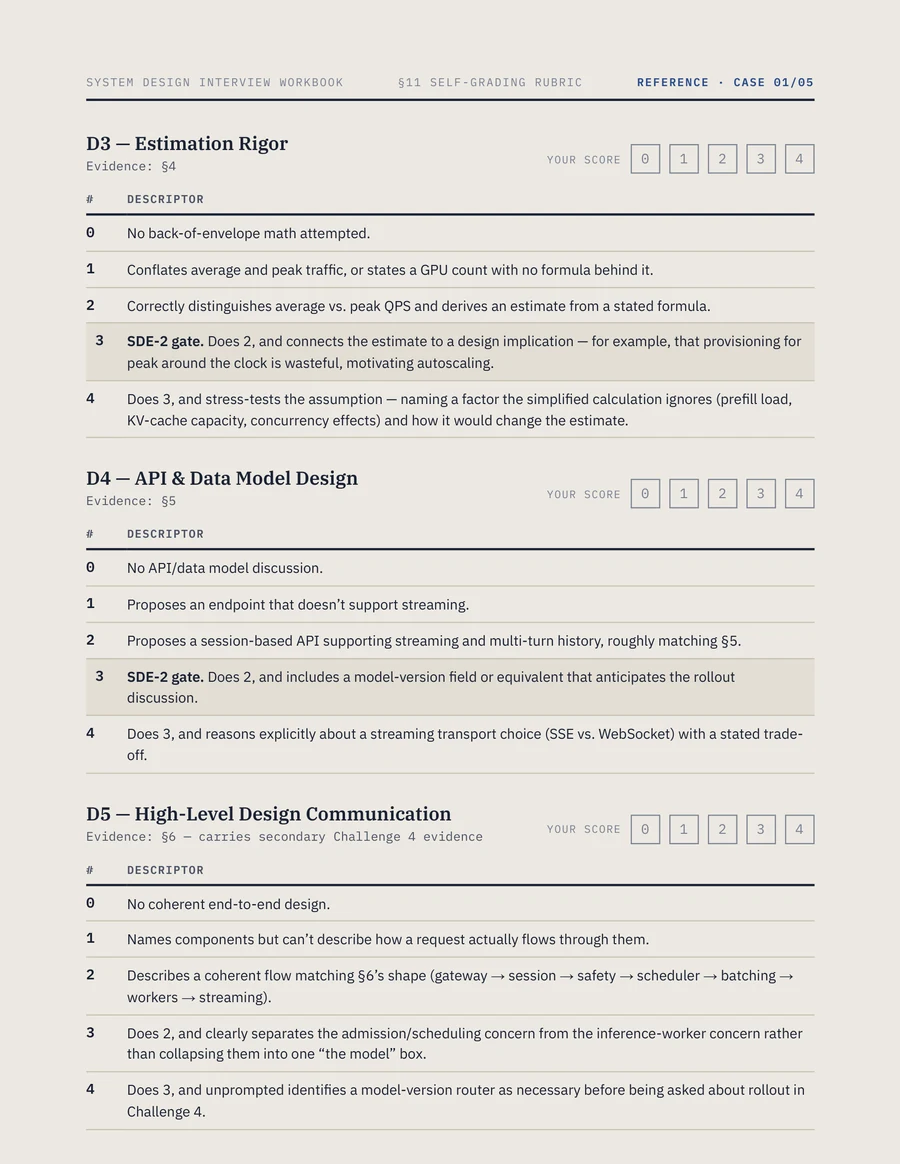
Score every attempt across 8 dimensions on a 0–4 scale, then read your total against the workbook's SDE-2 and SDE-3 practice-readiness benchmarks — before a real interviewer does.
The method
Every problem in Volume 1 runs the same eight steps, in the same order. The sequence is the product: it is what turns an hour of reading into an hour of interview reps.
Attempt→Commit→Defend→Compare→Grade→Repeat
See what you're actually getting
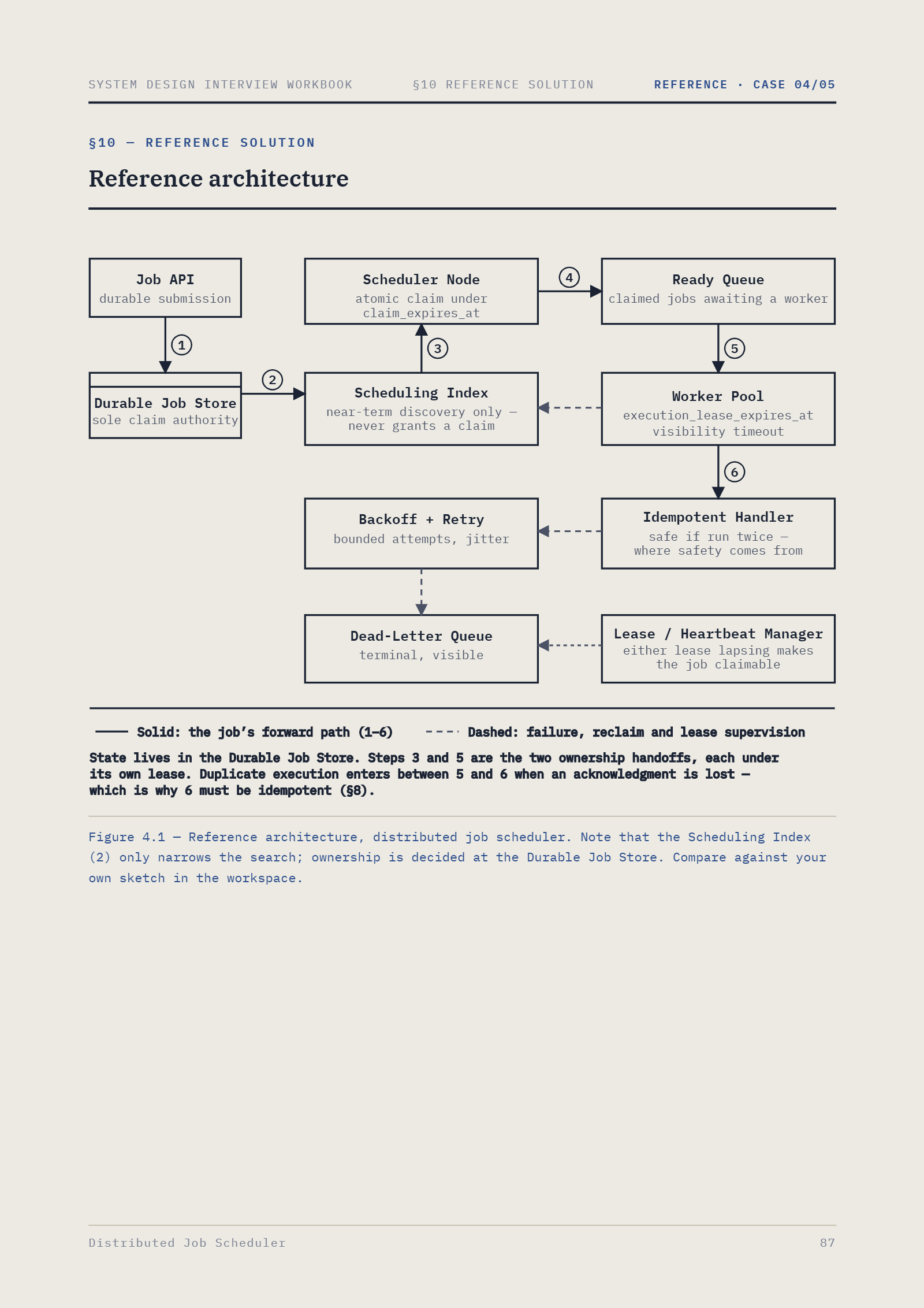
Real spreads from Volume 1, not mockups. Click any page to read it full size.
Inside Vol. 1
Modern AI infrastructure alongside the distributed-systems classics. Each problem runs the full 12-section arc — requirements, capacity math, architecture, deep dives, trade-off tables, a reference diagram, and grading.
Practice
Practice
Practice
Practice
Practice
Honest scoring
Honest fit
Two volumes
New to this? Start with Volume 1 — it builds the practice method on foundational problems. Ready for correctness under uncertainty? Volume 2 is the advanced set. Or get both and save.
Volume 1 · Foundational
one-time purchase
Secure checkout via Gumroad · 7-day refund window · eligibility applies
Prices in USD. Currency conversion and applicable taxes are shown at checkout.
Volume 2 · Advanced
one-time purchase
See the full Volume 2 page
FAQ
A 127-page professionally designed PDF, built for reading, printing and annotating. It works offline once downloaded, on any device that opens a PDF.
Mid-level to senior engineers preparing for SDE-2 / SDE-3 loops and equivalents. You should already know what a load balancer, cache and message queue are — the workbook trains you to assemble and defend designs under interview conditions.
No. It assumes working knowledge of core distributed systems building blocks and offers no beginner theory chapters. Learn the fundamentals first, then use this to practise.
Five complete interview simulations, each running the same 12-section arc: prompt, clarification, capacity estimation, architecture, deep dives, interviewer challenges, stop gates, trade-off tables, a reference architecture, and self-grading against the 32-point rubric.
It is a self-grading framework built around dimensions commonly evaluated in system-design interviews: eight dimensions scored 0–4. Use 20+/32 as the workbook's SDE-2 practice-readiness benchmark and 26+/32 as its SDE-3 practice-readiness benchmark. They are practice benchmarks, not official company hiring standards.
Checkout is handled by Gumroad. After payment you get an immediate download link for the PDF, plus an emailed receipt with permanent access to the same file.
Yes. Every revision of Volume 1 is free for buyers. Volume 2 is available separately or as part of the two-volume bundle.
Capacity math uses 2026-calibrated assumptions — GPU throughput and pricing ranges, current header standards, modern infrastructure patterns — and each chapter states the assumptions it reasons from rather than presenting one number as universal.
Refund requests may be submitted within 7 days; eligibility conditions apply. Because this is a digital product, refunds are intended for accidental duplicate purchases, technical issues preventing access to the files, or if the workbook materially differs from its description. Email contact@practicesystemdesign.com with your order details. See the Refund Policy for full details.
The whole idea
Set the timer. Clarify the problem. Estimate the load. Draw the architecture. Defend the trade-offs. Then stop, commit, and grade yourself — five times over. That's the rep this workbook is built to give you.