
01
Design an Agentic Task Execution Platform
The crux
When an irreversible tool call's outcome is unknown, what may you retry, and what must you verify first?
New · Volume 2 · Correctness Under Uncertainty
A practice-first workbook for SDE-2 / SDE-3 engineers who have to reason about retries, stale authorization, deletion, decision stability, and contention — the places where a plausible design quietly loses correctness.
251-page professionally designed PDF · 50 diagrams · 32-point D1–D8 rubric · Instant download
Free sample · no risk
Download the free sample and attempt Problem 1 — Agentic Task Execution: the prompt, clarification, capacity math, and the design, stopping right at the §9 Stop Gate before the reference solution. Real workbook pages, not a brochure.
The through-line
Volume 2 is about correctness when the system isn't sure what happened. An action fires; its outcome is unknown; you must verify authoritatively before you retry — or risk doing it twice, honoring stale authority, or resurrecting deleted data. Every problem is a different disguise of the same discipline.
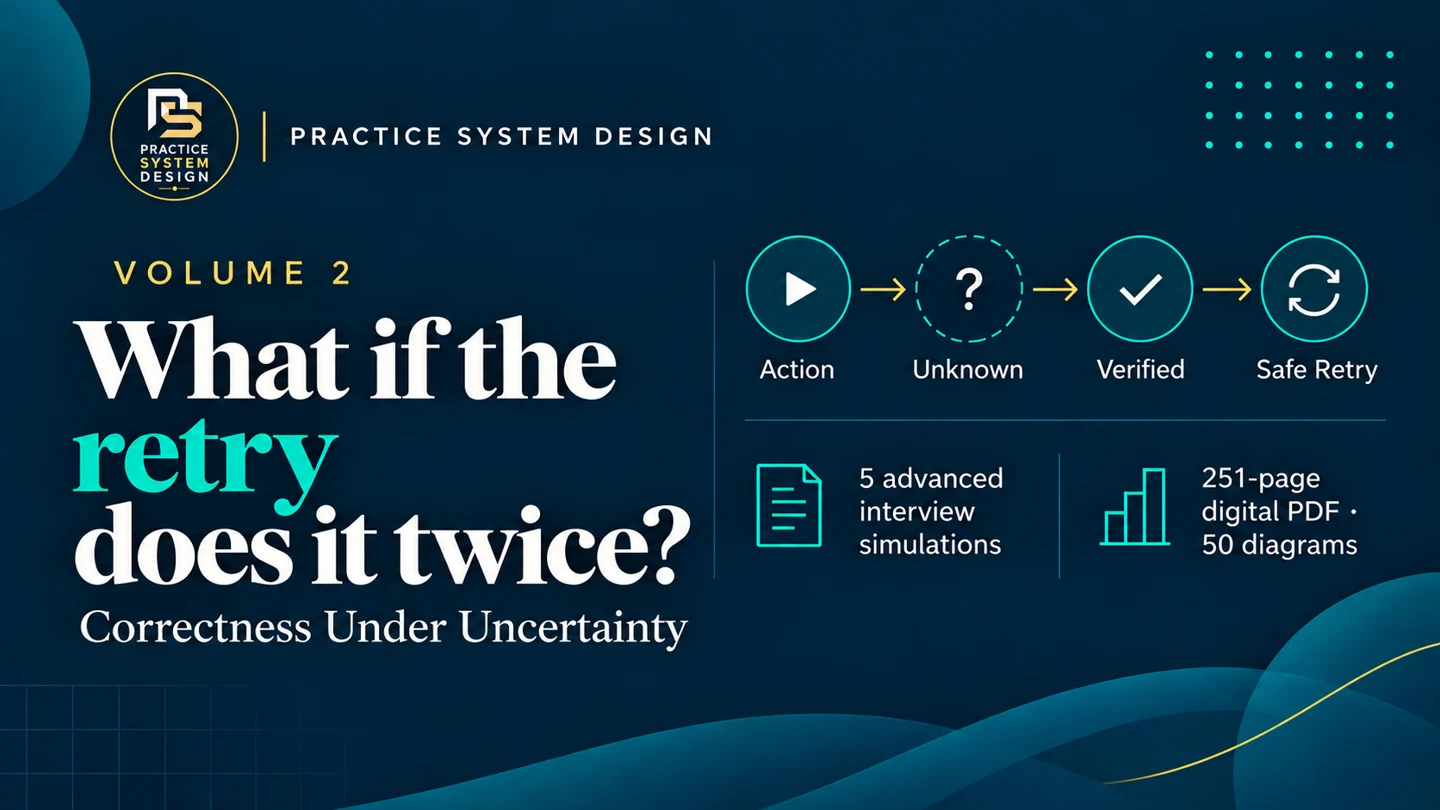
Action→ Unknown→ Verified→ Safe Retry
The one rule — verify before you retry.
Inside Volume 2
Each runs the full 16-section arc — prompt, clarification, capacity math, architecture, deep dives, interviewer challenges, a Stop Gate, trade-off tables, reference diagrams, and self-grading. Each turns on a single hard question.
The crux
When an irreversible tool call's outcome is unknown, what may you retry, and what must you verify first?
The crux
Who is authorized under the request's declared contract — not merely "now"?
The crux
How does a deletion become a durable, dominant fact that replays, rebuilds, and restores cannot resurrect?
The crux
A committed decision must be replayed on retry, not re-scored across a model rollout.
The crux
When payment and hold-expiry race for one scarce seat, where is the single deciding transition?
See what you're actually getting
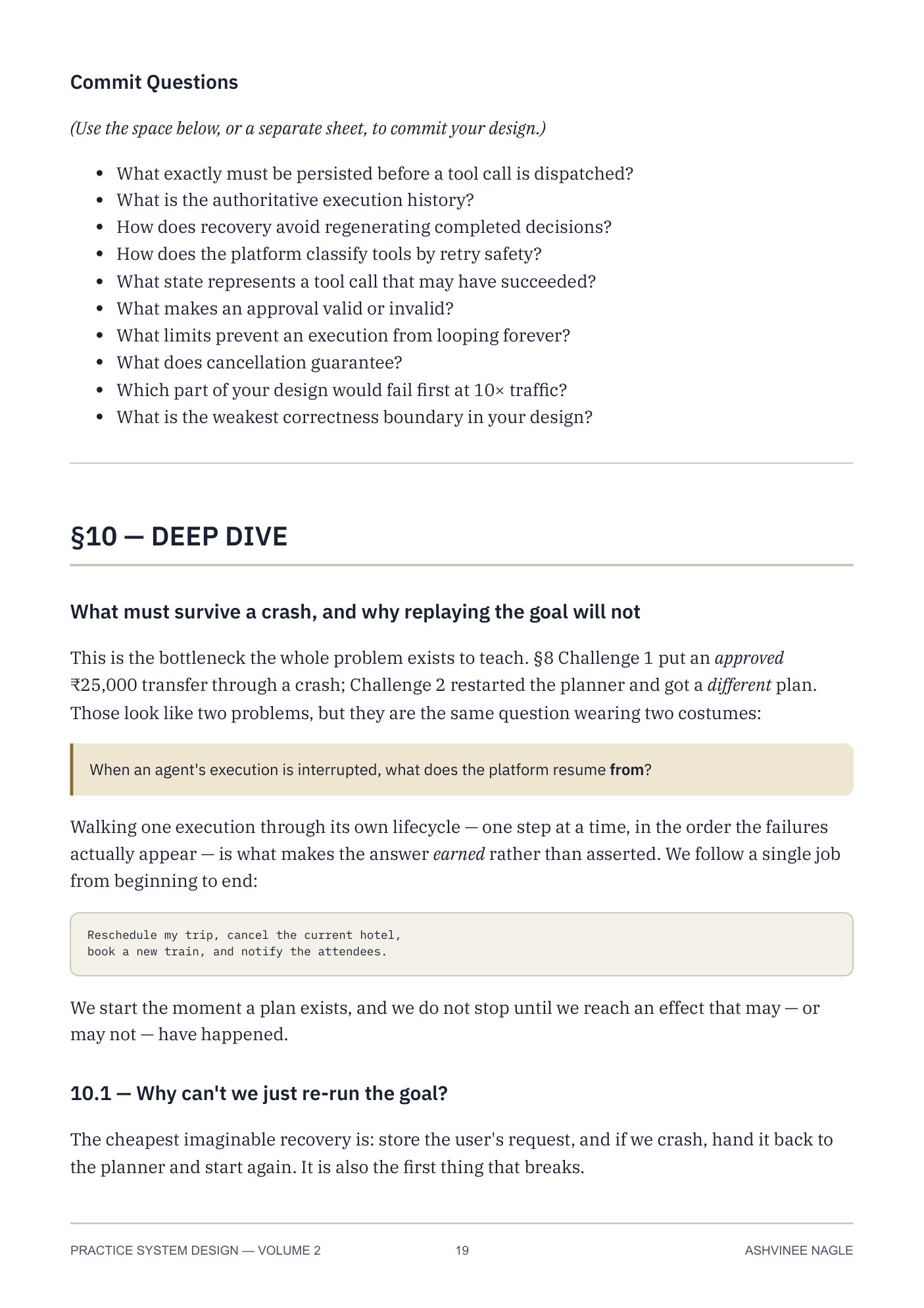
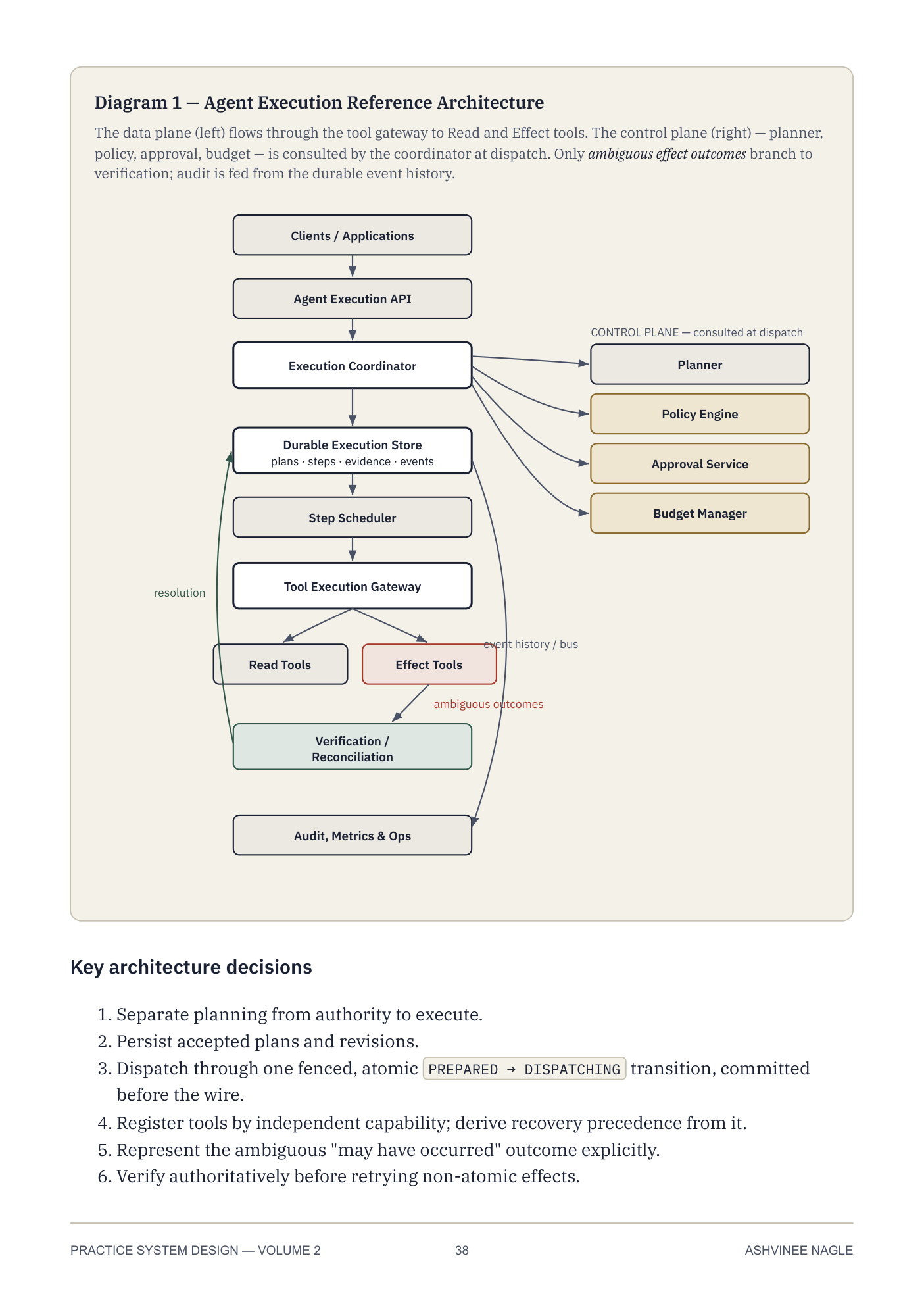
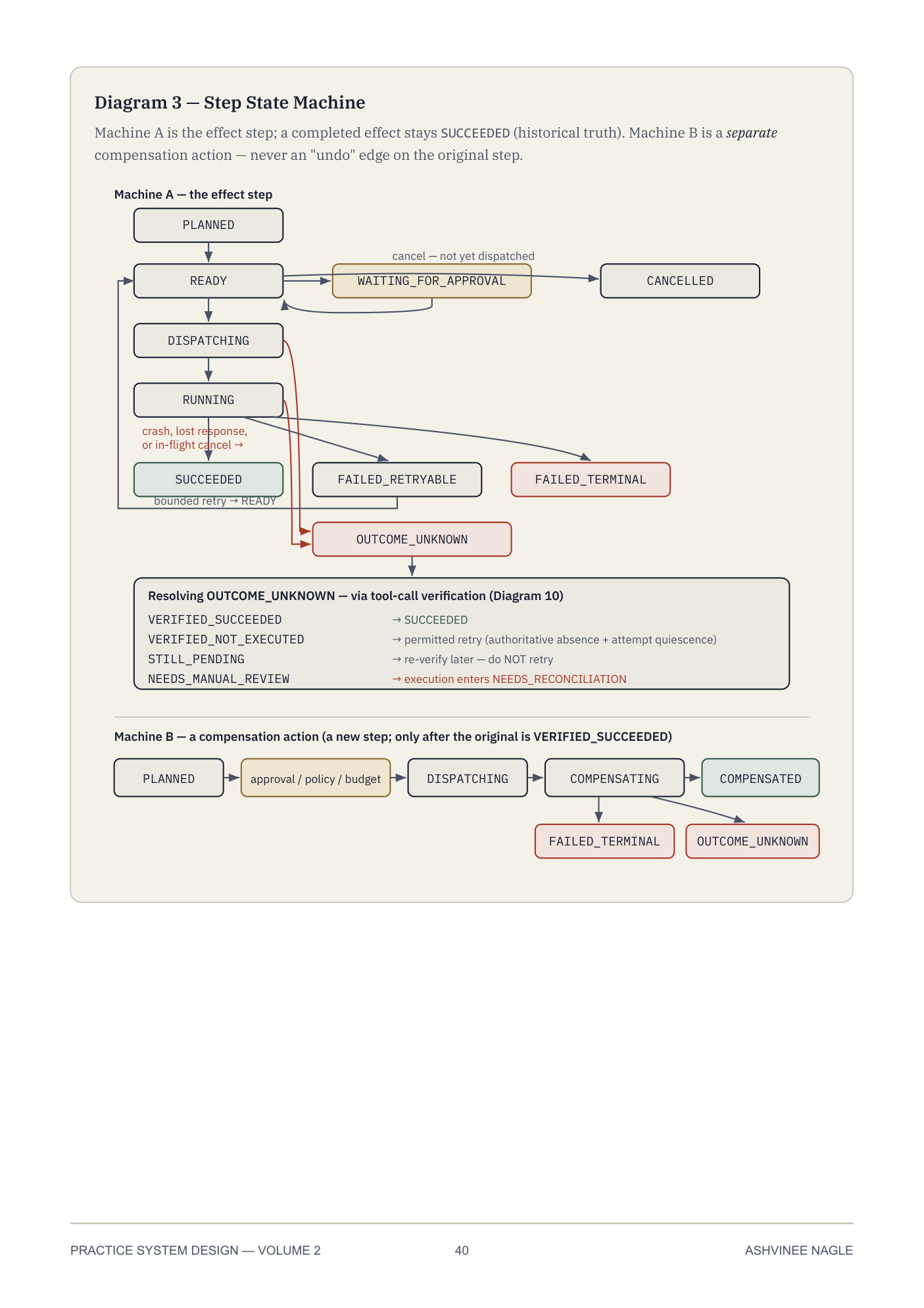
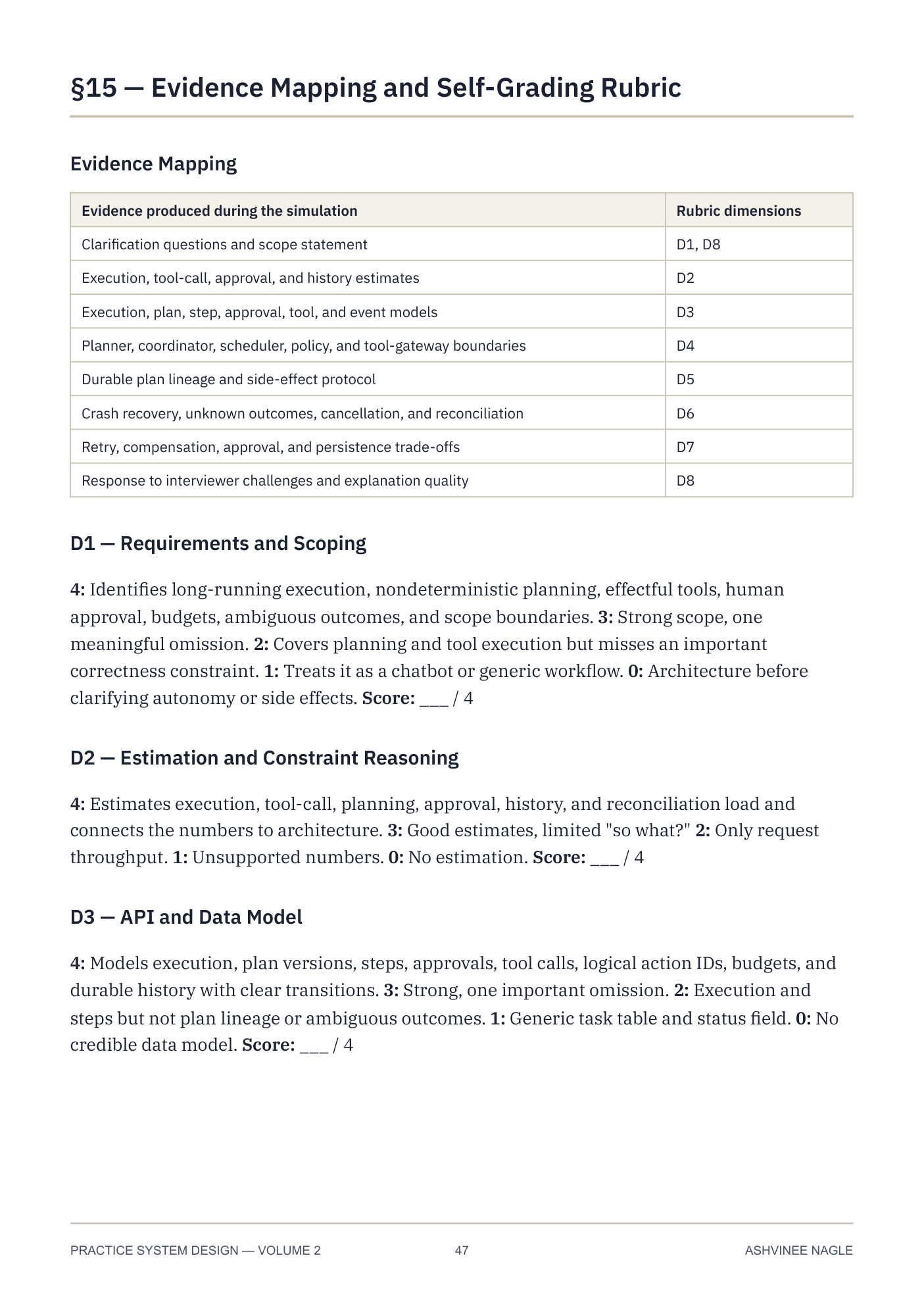
Actual pages from the 251-page workbook, not mockups. Click any page to read it full size.
How each problem is built
The same disciplined sequence carries every problem — the structure is the product. Three mechanics do the heavy lifting.
At §9 the workbook stops you: write your requirements, your capacity math, and your design. Only then do you compare against the reference solution. No passive scrolling past the hard part.
Each problem includes the pushback a real interviewer applies — the plausible-but-wrong follow-ups that test whether your design actually holds once the outcome is uncertain.
Score every attempt across eight dimensions, 0–4, mapped to the evidence you produced. Read your total — and the gate dimensions — before a real interviewer does.
Honest scoring
Honest fit
Get Volume 2
Buy Volume 2 on its own, or get both volumes for $39 — $9 less than buying them separately.
Volume 2 only
one-time purchase
Secure checkout via Gumroad · 7-day refund window · eligibility applies
Prices in USD. Currency conversion and applicable taxes are shown at checkout.
Volume 1 + Volume 2
both workbooks · one-time purchase
Secure checkout via Gumroad · 7-day refund window · eligibility applies
Prices in USD. Currency conversion and applicable taxes are shown at checkout.
Already own Volume 1? Use code V1OWNER at checkout for Volume 2 at $19.
| Volume 1 | Volume 2 | |
|---|---|---|
| Focus | Foundational patterns & the practice method | Correctness under uncertainty |
| Problems | LLM serving, feed, rate limiter, scheduler, collaborative editor | Agentic execution, permission-aware retrieval, distributed deletion, payment risk, ticketing |
| Arc | 12-section simulation | 16-section simulation + Stop Gate at §9 |
| Rubric | 32-point, 8 dimensions | 32-point D1–D8, with gate dimensions |
| Length | 127-page PDF | 251-page PDF · 50 diagrams |
| Level | SDE-2 → SDE-3 | SDE-3 / staff correctness reasoning |
FAQ
No — Volume 2 is standalone. It assumes you're comfortable with core distributed-systems building blocks, but it doesn't depend on Volume 1's problems. If you want the full path from foundational to advanced, the bundle gives you both.
Volume 1 builds the practice method across foundational problems. Volume 2 is the advanced volume: five problems centred on correctness under uncertainty — retries, stale authorization, deletion, decision stability, and contention — with a longer 16-section arc, a Stop Gate at §9, and the D1–D8 rubric with gate dimensions.
A 251-page professionally designed PDF with 50 diagrams, built for reading, printing and annotating. It works offline once downloaded, on any device that opens a PDF. Purchase includes the Practice Pack and a Read-Me guide.
Senior engineers preparing for SDE-3 / staff-level loops, and strong SDE-2s who want to practise correctness reasoning. You should already know what a load balancer, cache, queue and consensus protocol are — the workbook trains you to defend designs when outcomes are uncertain.
At §9 of every problem the workbook stops and asks you to commit your design — requirements, capacity math, and architecture — before it shows the reference solution. It's the mechanic that turns reading into interview reps.
Checkout is handled by Gumroad. After payment you get an immediate download link for the PDF and bonuses, plus an emailed receipt with permanent access to the same files.
Yes. Every revision of Volume 2 is free for buyers.
Refund requests may be submitted within 7 days; eligibility conditions apply. Because this is a digital product, refunds are intended for accidental duplicate purchases, technical issues preventing access to the files, or if the workbook materially differs from its description. Email contact@practicesystemdesign.com with your order details. See the Refund Policy for full details.
The whole idea
Clarify the problem. Estimate the load. Draw the architecture. Then commit at the Stop Gate, compare against the reference, and grade yourself on the dimensions that decide correctness — five times over.